What Is a vIBAN and How Does It Work for GCC Businesses?
A virtual IBAN lets GCC businesses receive international transfers without a local bank account in every country. How vIBANs work, who issues them, and what to ask a provider.
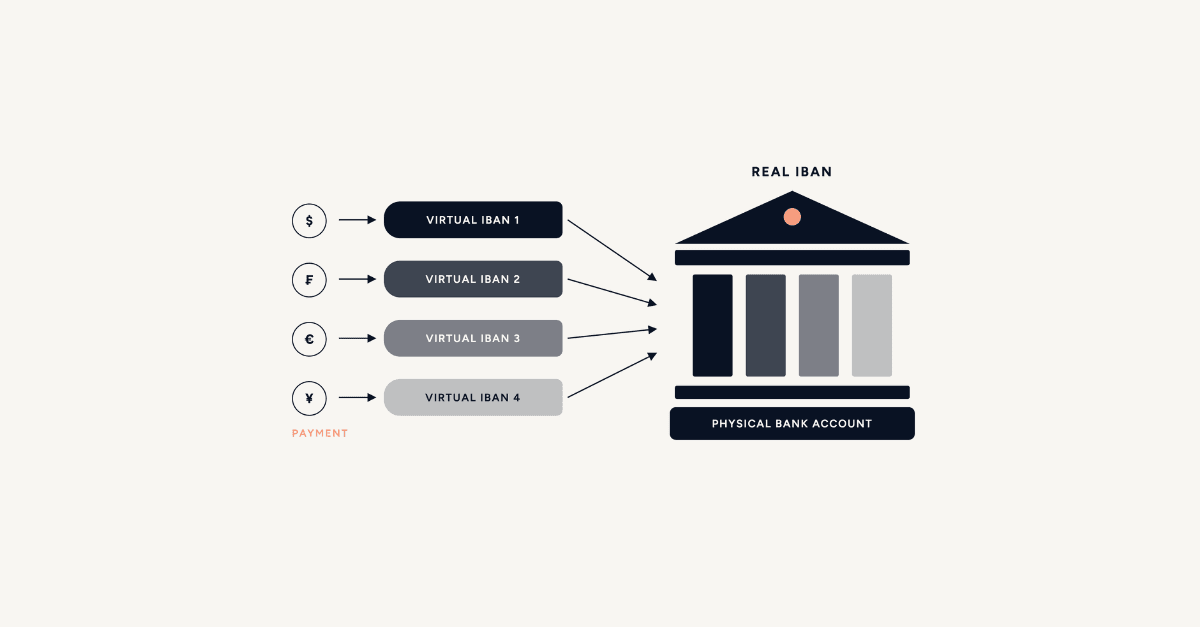
A GCC business receiving international transfers from overseas clients today typically relies on SWIFT wires into a local bank account, which requires maintaining a bank account in each country where clients operate. A virtual IBAN (vIBAN) solves a specific part of that problem: it is a unique account number assigned to a specific business, client, or transaction that routes international transfers to a central master account held by a licensed banking institution, without requiring a physical bank account in the sending country.
For GCC businesses managing multi-corridor collections, payments from India, Europe, or the US arriving into the same operation, vIBANs allow each transfer to be automatically attributed to the correct client or entity, eliminating manual reconciliation. Named-transfer compliance, a regulatory requirement in the UAE, is handled at the vIBAN level.
What is a virtual IBAN (vIBAN) and how is it different from a standard IBAN?
A vIBAN follows the same ISO 13616 IBAN format as a regular bank account number; it is structurally identical and accepted by any bank processing a standard transfer. The difference is in what the number maps to. A standard IBAN maps to a single physical bank account. A vIBAN is a unique identifier that routes to a central master account held by a licensed banking institution, while preserving a complete record of which client, entity, or transaction the incoming funds belong to.
The practical implication: the sender does nothing differently. They enter the vIBAN as the beneficiary account number and make a standard bank transfer, SWIFT, SEPA, or a local rail. No special software, no additional instructions. The routing, attribution, and reconciliation happen on the receiving infrastructure.
One regulatory point that applies in the UAE: vIBANs must be issued by a licensed bank holding customer accounts for electronic payments. The CBUAE states that no party other than an authorised bank is permitted to generate an IBAN. When a fintech or payment operator provides a vIBAN to a client, that IBAN is generated and backed by a licensed banking partnerM not by the fintech directly. (CBUAE IBAN Standards, centralbank.ae)
The UAE IBAN format: country code AE + 2 check digits + 3-digit bank identifier + 16-digit account number = 23 characters total. Mandatory for all UAE electronic payments since April 2012. (CBUAE IBAN Standards, centralbank.ae)
How does a vIBAN work? The step-by-step mechanics
The mechanics of a vIBAN payment follow five steps. The sender's experience is identical to a standard bank transfer throughout.
- Assignment. A unique vIBAN is issued by the operator's licensed banking partner and assigned to a specific client, entity, or transaction. This can be done programmatically via API for high-volume operations, or manually for lower-volume use cases.
- Transfer. The sender makes a standard bank transfer - SWIFT wire, SEPA credit transfer, or local rail - using the vIBAN as the beneficiary account number. No special instructions or account type is required on the sender's side.
- Routing. The transfer arrives at the banking partner's master account. The vIBAN identifier in the transaction record tells the system exactly which client or entity the funds belong to.
- Attribution and reconciliation. Funds are attributed to the correct client account in the system automatically. Because every vIBAN is unique to one client or transaction, reconciliation does not require manual matching of reference numbers or payment descriptions.
- Payout or processing. Funds are processed according to the operator's instructions, paid out to the named beneficiary, converted to the required currency, or held in the client's balance.
The reconciliation step is where the commercial value concentrates. In operations processing hundreds of inbound transfers from multiple clients or markets, manual reconciliation of reference numbers is a resource-intensive process. A vIBAN structure eliminates it.
Dimension | Standard Bank Transfer | vIBAN Transfer |
|---|---|---|
Sender experience | Standard bank transfer | Identical — standard bank transfer |
Recipient requirement | Physical bank account per country | No local bank account required in sending country |
Reconciliation | Manual reference matching | Automated via unique vIBAN identifier |
Named transfer compliance | Requires specific bank setup | Built in — beneficiary name on record |
Scalability | One account per entity | API-provisioned, multiple per client |
Issued by | Any bank | Licensed banking partner only |
What do GCC businesses use vIBANs for?
Receiving payments from international clients. A GCC business with clients in Europe, South Asia, or the US can assign each client a dedicated vIBAN. The client transfers in their local currency via a standard bank transfer; funds arrive and reconcile automatically. The GCC business does not need a bank account in the client's country.
Multi-corridor settlement and payroll. Businesses managing payments across multiple countries - inbound from clients in several markets, outbound to suppliers or employees in others - use vIBAN infrastructure to receive and hold multi-currency balances. This is particularly relevant for exchange houses and PSPs managing high transaction volumes. For context on how exchange houses restructure the capital implications of multi-corridor settlement, see eliminating Nostro pre-funding for GCC exchange houses.
High-volume B2B reconciliation. Exchange houses and payment processors handling hundreds of daily transactions use vIBAN structures specifically to automate reconciliation — replacing manual reference-number matching with automatic attribution.
Named beneficiary compliance in the UAE. Cross-border payouts within the UAE's regulated payment environment require transfers to be made to named beneficiaries. A vIBAN ensures the beneficiary name is correctly attributed on the transfer record, satisfying this compliance requirement. (CBUAE IBAN Standards, centralbank.ae)
For GCC businesses evaluating how digital asset rails interact with this infrastructure, how cross-border digital asset settlement works covers the settlement layer.
What is the regulatory basis for vIBANs in the GCC?
UAE. The CBUAE mandated the IBAN standard for all UAE electronic payments, implemented in November 2011 with mandatory compliance from April 2012. The UAE IBAN format is 23 characters: AE + 2 check digits + 3-digit bank identifier + 16-digit account number. The CBUAE is explicit that only banks holding customer accounts for electronic payments are authorised to generate IBANs, no other party is permitted to do so. Any vIBAN offered by a non-bank operator is generated through and backed by a licensed banking partner. (CBUAE IBAN Standards, centralbank.ae)
Purpose codes - mandatory for UAE inbound transfers. Cross-border transfers into the UAE must include a purpose code identifying the nature of the transaction. Commonly referenced codes include GDE (goods purchased), STS (services), FAM (family support), and SAL (salary/payroll). vIBAN providers operating in UAE corridors must handle purpose code attribution correctly — transfers missing a valid purpose code risk being flagged or rejected by receiving banks. [Confirm with team: verify the exact CBUAE circular or regulation mandating purpose codes on inbound transfers before publishing. Confirm primary source URL with compliance team.]
Bahrain. The CBB applies IBAN standards consistent with ISO 13616 requirements. The same principle applies, only licensed institutions issue IBANs.
Compliance scope. vIBAN infrastructure handles routing and reconciliation. It does not replace the sender's compliance obligations. KYC, AML screening, and purpose code requirements still apply on the sending side. For a full account of the CBB Category 3 licence and what it authorises in the Bahrain context, that article covers the regulatory framework in detail.
What should GCC businesses ask before choosing a vIBAN provider?
Who issues the IBAN? The IBAN must be generated by a licensed banking institution, not the operator directly. Ask: which bank is your vIBAN issuing partner, and what is that bank's regulatory status in the relevant jurisdiction?
Which currencies and corridors are live? vIBAN coverage varies substantially between providers. Confirm which currency denominations are currently supported (AED, USD, EUR, GBP, SAR) and which sending corridors are operational, not planned or roadmap items.
How are purpose codes handled? For UAE inbound transfers, purpose codes are a regulatory requirement. Ask whether the system handles purpose code attribution automatically, or whether the sender is responsible for including the correct code manually.
What reconciliation reporting is available? Request a sample statement showing how individual vIBAN transfers are identified and attributed. The reconciliation benefit is the primary operational value of a vIBAN structure, verify it works as described before committing volume.
What is the named transfer compliance process? In regulated GCC corridors, the beneficiary name on the vIBAN record must match the transfer instruction. Ask how the provider handles name discrepancies, and what the escalation process is when a compliance check fails.
For businesses evaluating the full range of payment infrastructure options - including OTC fiat-to-USDT conversion for payment settlement - the due diligence questions are structurally similar: licence type, issuing authority, and live corridor coverage.
A vIBAN simplifies the receive side of international transfers by removing the requirement for a physical bank account in every country, while maintaining full named-transfer compliance through standard IBAN infrastructure.
ARP Digital works with licensed vIBAN infrastructure within its GCC payment operations. The banking partners that issue IBANs within ARP's network hold the relevant regulatory authorisations in their respective jurisdictions, meaning every IBAN in the network is issued by a regulated institution, in full compliance with CBUAE and CBB requirements.
For businesses evaluating cross-border settlement infrastructure in the GCC, inbound collections, outbound settlement, or multi-corridor payment flows, learn how ARP Digital settles cross-border settlements →
Frequently Asked Questions
A virtual IBAN (vIBAN) is a unique account number that follows the ISO 13616 IBAN standard and routes incoming transfers to a central master account held by a licensed banking institution. It functions identically to a standard IBAN from the sender's perspective, a regular bank transfer is all that is required. On the receiving side, each vIBAN is uniquely assigned to a client, entity, or transaction, enabling automated reconciliation without manual reference matching.
A regular IBAN maps to a single physical bank account. A virtual IBAN routes to a master account at a licensed banking partner, with a unique identifier that attributes each incoming transfer to the correct client or transaction. The sender's experience is identical in both cases. The difference is structural: vIBANs allow one master account to receive and automatically reconcile transfers from multiple clients, each identified by their unique vIBAN.
Yes. A GCC business with overseas clients can assign each client a dedicated vIBAN. The client makes a standard bank transfer to that vIBAN from their local account; the funds route to the master account held by the licensed banking partner and are attributed to the correct client automatically. No local bank account in the sending country is required on the GCC business's side.
Only banks holding customer accounts for electronic payments are authorised to generate IBANs in the UAE. The CBUAE states that no other party is permitted to do so. A fintech or payment operator offering vIBANs generates and issues them through a licensed UAE banking partner - the IBAN itself is a product of that bank, with the payment operator handling the assignment and routing layer on top. (CBUAE IBAN Standards, centralbank.ae)