Local Rails vs Correspondent Banking: A GCC Comparison
Local rails and correspondent banking solve different problems. How they compare on reach, cost, capital and risk, and when each is the right tool. Slug: local-rails-vs-correspondent-banking
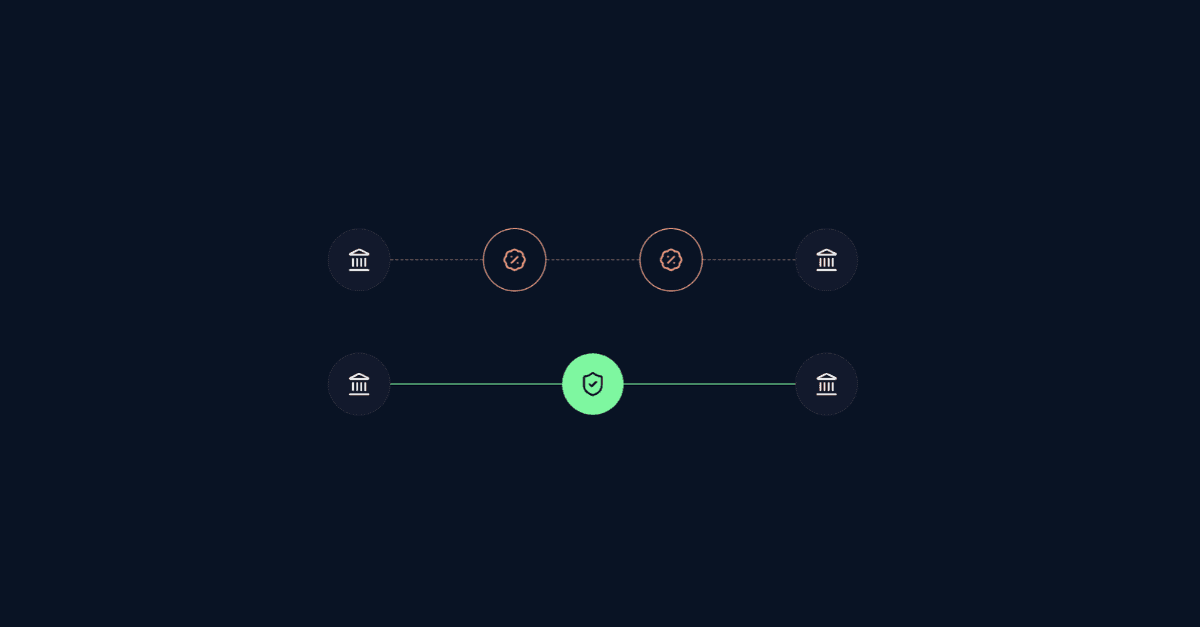
A cross-border payment reaches its destination one of two ways.
It can travel through a chain of intermediary banks, correspondent banking, the arrangement that has moved money across borders for decades. Or it can reach the destination country's own domestic payment system directly, through a provider that already holds a banking relationship there.
Businesses increasingly ask which they should be using. The honest answer is that most end up using both, because the two solve different problems. Correspondent banking buys reach at the cost of intermediaries. Local rails remove the intermediaries at the cost of reach.
This article sets out how they differ, why the correspondent network has been shrinking, and how to decide which payments belong on which route.
How correspondent banking works
A bank in Dubai cannot credit an account in Manila. It has no presence there, no account at the receiving bank, and no way to move value into the Philippine banking system on its own.
What it has instead is a relationship with a correspondent, a bank that holds an account for it and can make payments on its behalf. If that correspondent also cannot reach Manila, it uses its own correspondent. The payment moves down the chain until it arrives at an institution that can credit the beneficiary.
The BIS describes the mechanism plainly: a correspondent bank provides local account and payment services for banks based abroad, and because a payment can only travel where an account relationship exists, several payments between different intermediary banks may be necessary for a single underlying transaction.
Each link in that chain is a separate bilateral relationship, with its own account, its own fees, and its own compliance checks. That structure is what gives correspondent banking its reach, and it is also where its cost comes from.
How local rails work
Every country runs a domestic payment system, the infrastructure its own banks use to move money between domestic accounts. India has IMPS and RTGS. The Philippines has Instapay and Pesonet. The eurozone has SEPA.
A provider holding a banking relationship in the destination country can reach that system directly. The payment arrives into domestic clearing rather than being passed down a chain of foreign banks, and the final leg behaves like a local transfer, because that is what it is.
The limitation is obvious once stated. This only works where the provider has built a relationship. Correspondent banking reaches almost anywhere; local rails reach a list.
Why the correspondent network has been shrinking
The number of correspondent relationships has been falling for over a decade, and this is the fact most often cited in this debate, usually inaccurately. It is worth being precise about what the data shows.
The BIS Committee on Payments and Market Infrastructures published an annual review of correspondent banking built from SWIFT payment message data across more than 200 jurisdictions. Its definitions are narrow. An active correspondent is a bank that sent or received at least one payment message during the year. An active corridor is a one-direction country pair that processed at least one message during the year.
That matters, because a relationship only leaves the dataset when not a single payment message crosses it in a full year. These are not relationships that got quieter. They stopped.
In its May 2019 commentary on end-2018 data, the CPMI found active relationships had declined by about 20% over the preceding seven years, with active corridors down roughly 10%. In 2018 alone, relationships fell about 3.5% and corridors about 2%. The decline was uneven: on that data, the Americas excluding North America had lost around 30% of active relationships since 2012, against roughly 10% in North America.
But the more revealing finding sits alongside it. Message volumes rose over the same period. Fewer relationships carrying more traffic means the network did not so much shrink as concentrate, the same payments routing through fewer institutions.
Two caveats the BIS states itself, and which most coverage omits. SWIFT flows do not represent complete industry statistics, since institutions exchange transaction information by other means. And payment chains cannot be identified in the data, so the number of intermediaries any given payment crosses is not something this dataset measures.
One further point on currency. The CPMI and SWIFT committed to the Financial Stability Board to publish the review annually until 2023 and fulfilled that with the end-2022 edition. There is no newer release. Figures circulating for later years are extrapolations or come from elsewhere.
Why it happened is not mysterious. Maintaining a correspondent relationship requires continuous compliance investment: transaction monitoring, sanctions screening, due diligence on the respondent bank, reporting. Where a relationship carried low volume or served a higher-scrutiny corridor, that cost came to exceed the revenue it produced, and the bank closed it.
For a business, this is why adding a new corridor has become a harder conversation than it was ten years ago.
Where the cost difference comes from
Three components, and only one is normally visible to the sender.
Handling fees at each intermediary. A correspondent deducts a charge for processing an incoming payment, taken from the principal in transit rather than invoiced. The recipient receives less than the sender remitted, and the shortfall often appears on no statement either party sees. A payment crossing two intermediaries absorbs two of these.
Where the exchange rate is applied. In a correspondent chain, conversion commonly happens at the destination correspondent - after the payment has been committed and left the sender's account. The rate quoted at initiation is the originating bank's expectation, not a fixed price. On a local rail the rate is typically set at initiation, before commitment.
Capital in place. Each link in a chain needs funded positions to operate. That capital is immobilised, and its financing cost is embedded in pricing rather than itemised. Where working capital gets trapped explains why those positions cannot simply be moved when needed.
For scale: the World Bank's Remittance Prices Worldwide reported a global average cost of 6.36% for sending the equivalent of USD 200 in its Q3 2025 issue, with commercial banks averaging 14.99% and digital-only money transfer operators 3.54%. Much of that gap is a function of how many intermediaries sit in the chain. The series is quarterly and the figures move.
Is one actually faster?
This is where the comparison is most often overstated.
The intuition is that more intermediaries means slower delivery, so removing them must make payments faster. The data does not support that as a general rule, because most of the elapsed time in a cross-border payment is not spent in transmission. It is spent at the beneficiary bank, its processing windows, compliance checks and cut-off times. Swift's own research into last-mile delays has made this point repeatedly.
A payment can clear a correspondent chain quickly and still take days to reach the account. Changing the rail does not change what the beneficiary bank does with it.
The defensible case for local rails is capital efficiency and rate certainty, not speed. Where routing genuinely changes timing is on corridors whose domestic infrastructure runs continuously. India's IMPS and RTGS both operate around the clock, so a payment reaching them can credit outside banking hours — but that is a feature of the destination country's infrastructure rather than of the routing decision.
How they compare
Dimension | Correspondent banking | Local rails |
|---|---|---|
Geographic reach | Near-universal. Any corridor with a surviving chain | Only where the provider holds a relationship |
Currency coverage | Broad. Effectively any convertible currency | Limited to supported corridors |
Intermediaries | One or more, depending on the corridor | None on the destination leg |
Cost structure | Transaction fee, FX spread, handling fee at each intermediary, destination receiving charges | Transaction fee and FX spread |
Rate certainty | Rate often applied downstream, after commitment | Rate typically fixed at initiation |
Working capital | Funded positions required at each link | Fewer positions in the chain |
Counterparty concentration | Diversified. No dependence on one provider | Single-provider dependency |
Legal and dispute framework | Long-established, with documented recourse | Varies by provider and jurisdiction |
Setup effort | Already in place for most businesses | New relationship, new onboarding |
Compliance checks | Sequential, at each intermediary | Fewer points, consolidated |
What correspondent banking still does better
Correspondent banking wins five rows of that table, and they are not consolation prizes.
Reach. A correspondent chain can deliver to almost any country with a functioning banking system. Local rails reach a list, and that list is shorter than most providers' marketing implies.
Currency coverage. The same logic. Correspondent banking handles currencies no direct provider offers.
No counterparty concentration. A business routing everything through one provider depends on that provider's licence, solvency and operational continuity. Correspondent banking spreads that across institutions with long operating histories.
Established recourse. When a correspondent payment goes wrong, the dispute process is documented and well tested. With a newer provider it depends on that provider, its jurisdiction and its contract.
It already exists. Most businesses have correspondent access through their existing bank. Adding a local rail provider means onboarding, due diligence, integration and another relationship to maintain. That cost is real, and the payment volume has to justify it.
Any comparison showing local rails winning every row is selling something.
So which should a business use?
The question is rarely all or nothing. It is which payments belong on which route.
Local rails make sense when volume concentrates in a few corridors, payments are frequent rather than occasional, per-payment cost is material at the volumes involved, knowing the rate at initiation has operational value, and the destination has usable domestic rails the provider actually reaches.
Correspondent banking makes sense when destinations are many and scattered, volume per corridor is low, the currency sits outside any direct provider's coverage, single-provider concentration is unacceptable on policy grounds, or the payment is one-off and the setup cost cannot be justified.
A practical test. Take twelve months of outbound payments and sort by corridor. If three corridors carry most of the value, those three are candidates for a direct rail and the long tail stays where it is. If value spreads evenly across twenty destinations, the economics do not support building direct coverage.
Most businesses of any scale end up running both, and routing by corridor rather than replacing one with the other.
Frequently Asked Questions
Correspondent banking routes a payment through a chain of intermediary banks until it reaches one that can credit the beneficiary. Local rails reach the destination country's domestic payment system directly, through a provider holding a banking relationship there. Correspondent banking offers wider reach; local rails remove intermediaries from the destination leg.
In its May 2019 commentary on end-2018 data, the BIS Committee on Payments and Market Infrastructures reported active correspondent relationships down about 20% over the preceding seven years, with active corridors down roughly 10%. The dataset counts a relationship as active if it carried at least one payment message during the year. The CPMI series concluded with its end-2022 edition.
Compliance cost. Maintaining a relationship requires transaction monitoring, sanctions screening, due diligence on the respondent bank and reporting. Where a relationship carried low volume or served a higher-scrutiny corridor, that cost exceeded the revenue it produced. Because message volumes rose while relationships fell, the result is concentration rather than collapse.
Usually on supported corridors, because they remove the handling fees each intermediary deducts from the principal and apply the exchange rate at initiation rather than downstream. The World Bank's Q3 2025 Remittance Prices Worldwide put the global average cost of sending USD 200 at 6.36%, against 14.99% for banks and 3.54% for digital-only operators. On corridors a provider does not reach, the comparison does not arise.
Less than commonly claimed. Most elapsed time in a cross-border payment is spent at the beneficiary bank rather than in transmission, and changing the rail does not change that bank's processing. The clearer advantages are capital efficiency and rate certainty. Timing does improve on corridors whose domestic rails run continuously.
Reach, currency coverage, counterparty diversification, established dispute frameworks, and the fact that most businesses already have access through their existing bank. For scattered destinations, unusual currencies or one-off payments, it remains the practical choice.
Rarely in full. Most businesses of any scale run both and route by corridor: direct rails where volume concentrates, correspondent banking for the long tail. Sorting twelve months of outbound payments by corridor usually makes the answer obvious.
Not necessarily. SWIFT is a messaging network rather than a settlement rail, and a payment can carry SWIFT messaging while still clearing on a domestic rail at the destination. What a direct route removes is the chain of intermediary banks between the originating institution and the beneficiary's.


